

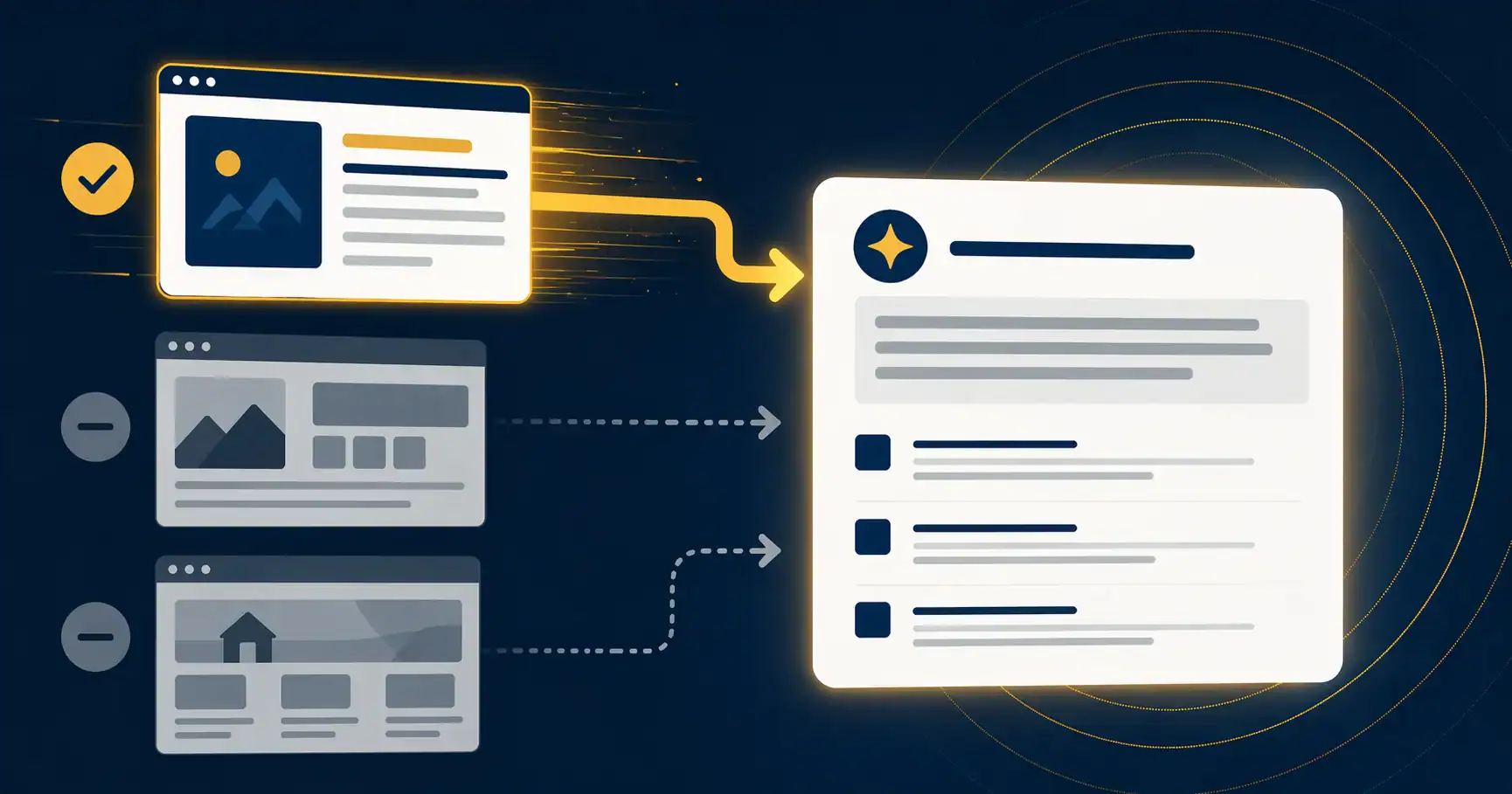
How to appear in Google AI Overviews is usually the wrong question when AI Overviews already cite your site as a source but the answer never says your brand name. In that case, stop looking for a sitewide fix. It is a page-type problem. Our audit of Lifts West, a Red River, New Mexico lodging client, found blog-style pages scoring 9 out of 10 on AI readiness while the homepage and older service pages scored 2 to 3 on the same domain, on the same topic, with very different structural fit for AI extraction. The fix sequence depends on which page types are broken, not on how many optimization tactics you apply site-wide.
Want to know which of your pages are cited but not named? Creative Options Marketing runs a diagnostic-led review that walks your top pages against the Page-Type Readiness Triage.
This guide shows how to diagnose your own site, what each page type needs structurally, and how Lifts West's January to March 2026 ranking data (SE Ranking, 68 tracked keywords, plus 37 positions on "condos in red river new mexico") and our separate AI Visibility audit reshaped where we tell small and mid-size business clients to put AI Overview effort first. Start with a ten-minute page-type inventory. If you cannot already name which of your pages read as blog-style versus brochure-style, the rest of this article will help you decide where to look first.
In This Guide
Key Takeaways
Google AI Overviews selects which pages to cite through a process that is not the same as organic ranking. A page can rank in the top ten and still be invisible in the AI answer, or it can be used as a source without the AI ever naming the brand that published it. The cleanest framing of the result space comes from LatticeOcean's March 2026 "authority mismatch" analysis: four outcomes are possible on any query, cited and mentioned (ideal), mentioned but not cited (brand recognition, no source credit), not mentioned and not cited (invisible), and cited but not mentioned (your content is the source, but the AI answer paraphrases it without naming you). That last state is where most small and mid-size brands with existing organic rankings actually live, and where most optimization budgets are spent on the wrong work.
LatticeOcean's fix framework treats authority mismatch as a per-page problem inside a domain, which of two overlapping pages is earning the citation, and how to redirect structural authority to the one you want cited. That is a real axis, and it holds up. But it is not the axis we see most often on Creative Options' client sites. The issue on a typical small-business site is not which of two competing pages gets cited; it is which page type on the site is even eligible to be named by the AI. Our reading, grounded in the Lifts West data below, is that brand-naming failure in AI Overviews correlates more strongly with page-type structural fit than with per-page selection between overlapping URLs. On multi-page-type sites (a homepage plus a blog plus service pages) uniform optimization spreads effort evenly across assets that need different amounts of it.
According to Google Search Central's canonical publisher guidance on AI features, "there are no additional requirements to appear in AI Overviews" beyond fundamental SEO. That is accurate at a policy level. The practical gap is that fundamental SEO does not teach page-type diagnosis. A reader who has already done the fundamentals (schema, canonical, crawlability, answer-first intros on new content) and is still cited-but-not-named does not get more help from a sitewide audit. They need a per-page-type lens.
The short version: walk your top five or six AI-Overview-eligible URLs, classify each as blog-style or brochure-style using the signals below, and treat any page scoring brochure on three out of four signals as your first-priority fix candidate. The scores in this article are first-party analyst judgments from our Lifts West audit, not a third-party-replicable rubric. The value is in the triage sequence, not in the numeric grade. We call this the Page-Type Readiness Triage; inside Creative Options' Apex Ranker System, it sits under the AI Overview pillar.
Four signals separate a blog-style page from a brochure-style page in AI-extraction terms:
Signal 1: Opening paragraph. A blog-style opener answers a query in the first two sentences. A brochure-style opener leads with a value statement ("Something for everyone"), a mission sentence, or a scene-setting image of the company. If your reader would still be looking for a direct answer at the end of the first 100 words, the page is brochure-style on this signal.
Signal 2: Headings. Blog-style pages use question-format H2s that mirror real queries ("How do I know which condo is closest to the lift?"). Brochure-style pages use category labels ("Accommodations," "Amenities," "About Us"). The category label tells the AI the topic area; the question header tells the AI what passage to extract.
Signal 3: Direct-answer blocks and lists. A blog-style page has at least one 40 to 60-word passage that reads as a standalone answer, plus at least one structured list or table. A brochure-style page runs on long prose paragraphs with embedded value claims. The prose may be well-written; it is harder for an AI to lift a passage from it without surrounding context.
Signal 4: Brand-entity placement. A blog-style page names the brand near the direct answer ("Lifts West sits closest to Chair 4, the main base chair"). A brochure-style page buries the brand in the footer, navigation, or site-wide template elements. When the AI extracts a passage, it takes the brand name with it only if the name appears inside the extractable passage, not merely somewhere on the page.
Score each target URL on the four signals. Three or four signals failing the blog-style test means the page is a priority-one candidate for structural revision. One or two failing means the page needs targeted brand-entity-placement work but not a full rewrite. Zero failing means the page is already earning its place in the AI answer and should be left alone while you fix the harder pages. Uniform "optimize everything" advice often causes regressions on pages that were already working.
The triage's value is that it gives you a decision (which three pages to fix first, which to leave alone) rather than a list of best practices to apply everywhere. On the Lifts West site, the next section shows what that decision looks like in practice.
Two separate observation streams exist on Lifts West, and it is important to keep them separate. The SE Ranking tracker we maintained through Q1 2026 is a record of organic position changes across 68 tracked keywords. The AI Visibility audit is a structural analysis of how a subset of those pages is currently read by AI systems. Both are first-party, both are Lifts West-specific, and neither is evidence for the other. This article draws on both; it does not fuse them.
Across the 68 tracked keywords, the January-to-March window showed meaningful movement on several high-intent hospitality queries. These are rank changes, not AI citation changes; SE Ranking does not track AI Overview presence directly.
| Keyword | Monthly search volume | Rank on 2026-01-01 | Rank on 2026-03-31 | Position delta |
|---|---|---|---|---|
| condos in red river new mexico | 590 | 44 | 7 | +37 |
| red river motels | 480 | 62 | 42 | +20 |
| red river ski resort lodging | 210 | 35 | 16 | +19 |
| hotels in red river | 9,900 | 31 | 19 | +12 |
Four brand-term variants (lifts west red river, lifts west red river nm, lifts west red river new mexico, lift west red river nm) held rank one on Google USA as of 2026-04-22. These rank improvements came out of Creative Options' ongoing organic SEO work on the site over the preceding period, which included technical cleanup, keyword mapping, and content additions. We are not claiming the AI Visibility audit findings below caused the rank improvements. The two streams measure different things and deserve separate framing.
The SE Ranking deltas above tell us Lifts West is increasingly visible in organic search across the Red River NM hospitality cluster. They do not tell us what happens when Google's AI Overviews lift a passage from one of those increasingly-visible pages to use as a source in an AI answer. That is what the second observation stream measures.
David Drewitz conducted a first-party AI visibility audit of the Lifts West site using SE Ranking, Google Search Console, Screaming Frog, and related tools as inputs. Each of five representative pages was reviewed against the same four signals described above and scored on a zero-to-ten analyst readiness assessment. The scores are not a third-party-replicable metric; they are David's judgment calls based on multi-tool inputs. For calibration: a 9/10 page passes all four signals cleanly with brand-entity placement landing inside extractable passages; a 5/10 page passes two of four signals (typically opening paragraph + headings, but fails direct-answer blocks and brand-entity placement); a 2/10 page fails all four signals: generic value-statement opener, category-label headings, prose-heavy without extractable passages, and brand entity living only in the site template.
| Page | AI readiness (David's assessment) | Reason |
|---|---|---|
| Best Places to Stay in Red River | 9/10 | Strongest page on the site for AI visibility |
| Things to Do in Red River NM in Winter | 8.5/10 | Good structure and direct-answer style |
| Red River NM Events | 8/10 | FAQ-heavy and easy for AI to quote |
| Explore the Resort | 3/10 | Reads like brochure copy, not an answer |
| Homepage | 2/10 | Too generic and not query-focused |
The gradient is the point. The same site, the same brand, the same topic area, scores ranging from 9 to 2 on the four-signal lens. Lifts West is already appearing as a source inside AI-generated answers for Red River queries such as "what to do in Red River NM," "red river ski in ski out," and "best places to stay in Red River NM." The audit confirmed a pattern we watch for on multi-page-type client sites: the AI answer paraphrases the page without attributing the brand by name: "a ski-in/ski-out condo near the slopes" instead of "Lifts West sits closest to Chair 4."
The brand entity sits in the site template rather than near the extractable passage. That single structural fact is what determines whether the AI answer says "a ski-in/ski-out condo near the slopes" or names the brand inside the citation passage.
The fix priority that falls out of these two scores is obvious: the homepage and the Explore the Resort page are the two pieces of real estate actively working against the brand in AI citations. Every other page is either already earning its place or has a narrower structural gap. A uniform "optimize the whole site for AI Overviews" initiative would have spent real budget on the 8-to-9 pages that did not need it, while leaving the 2-to-3 pages unchanged.
Want a diagnostic-led review of your site's AI Overview citation pattern?
Get a Diagnostic ReviewOr email david@creativeoptionsmarketing.com
The Page-Type Readiness Triage is tuned to Google AI Overviews, not to AI search generally. The four signals above reflect how Google's Gemini-generated answers select and extract passages from top-twenty organic results; they do not map cleanly onto ChatGPT's third-party-consensus weighting or Perplexity's heavy Reddit reliance. The citation pattern itself shifted on January 27, 2026, when Google upgraded AI Overviews globally to Gemini 3. A November 2025 Originality.AI study had found 52% of citations came from top-ten organic results before the upgrade, with post-upgrade measurements from Ahrefs reporting the figure dropped to roughly 38% afterward. Absolute citation share shifted; the page-type axis the four signals operate on did not. Search Engine Land's analysis of 8,000 AI citations found 82.5% of AI Overview citations link to deeply nested pages rather than homepages, a finding that holds across the upgrade because it measures structural depth, not citation volume.
ChatGPT and Perplexity work differently. Both weight third-party mentions (citations from publications, review sites, and community threads that reference your brand) more heavily than Google AI Overviews does. A page-type triage will improve a site's Google AI Overview visibility because it addresses Google's specific extraction mechanics. It will not by itself improve ChatGPT or Perplexity citation rates in any measurable way, because the selection logic on those platforms pulls from different signals entirely.
This is a scope point, not a limitation framing. If your buyer question is "how do I show up in AI search across every platform," our answer is that you will end up running three different programs in parallel, one per platform, because the platforms do not share selection logic. If your buyer question is the narrower one ("why do Google AI Overviews cite my site without naming my brand, and what do I fix first"), the page-type triage is the right tool. The Lifts West data set is Google AI Overview-specific; we do not have equivalent first-party data on ChatGPT or Perplexity citation patterns, and we do not extend the framework to those platforms without that data.
Each page type needs a different structural fix. The mistake most operators make is applying the same checklist (FAQ schema, question headings, brand mentions) to every page template uniformly. That spreads effort evenly across pages that needed different amounts of work. The scale of the gap is real: an April 2026 Otterly.AI study found 89% of brands now appear in AI search citations while only 14% of marketers track those citations. Most brands are losing or winning AI visibility unmeasured and uncorrected. The Lifts West audit pointed us toward three distinct fix patterns:
Homepage (2/10 in the Lifts West audit). A homepage rarely earns its place as an AI Overview citation source, and should not be optimized to try to. The homepage's AI Overview job is different: it is the entity-definition anchor for the brand. The fix is not to turn the homepage into a blog post. The fix is to make the first hundred words of the visible hero area clearly state what the brand is, who it serves, and where it is (in plain text, not image-overlay type) so that AI systems crawling the homepage can confirm the entity when a passage from another page on the same domain gets cited. On Lifts West, the recommendation was to tighten the hero-section copy from "something for everyone" generic language to a one-sentence brand definition tied to the Red River, New Mexico lodging category. Two real tradeoffs to weigh before applying this fix elsewhere: tightening hero copy from generic-aspirational to brand-definition-specific can affect conversion-rate performance on the homepage if the original copy was load-bearing for emotional appeal, and it can shift brand voice toward functional from inspirational. On Lifts West the tradeoff held, but the call belongs to the brand, not to the AI Overview optimization.
Brochure-style service pages (3/10, Explore the Resort page). These are the pages most often cited-but-not-named, because they sit in the structural middle. They target commercial queries like organic service pages, but they read like print brochure copy. The fix is the direct-answer-plus-FAQ pattern: rewrite the opening so the first 60 words answer the page's implied query, add three or four question-format H2s that mirror real buyer questions, and place the brand name inside the direct-answer passage rather than in the site navigation. This does not require turning the page into a listicle. It requires adding extractable passages to a page whose current prose is structurally unextractable.
Blog-style content (8-9/10, the strong pages in the Lifts West audit). These pages are already earning their place. The fix here is smaller and targeted: verify that the brand is named at least once inside the answer passage for the page's primary query, and add one or two internal links from the strong blog pages to the weaker service pages so the AI system can map the brand entity across the domain. Do not rewrite strong pages. Operators who try to "optimize further" on already-working content frequently cause rank regressions; the underlying volatility of AI Overview citations themselves is part of the reason, with Semrush's URL volatility study finding that 91% of URLs cited inside AI Overviews are removed at some point in the observation window.
None of these fixes is novel in isolation. The part that is ours is the sequencing: diagnose the page type first, match the fix to the type, skip the uniform pass. If you want a diagnostic-led review of your site's AI Overview citation pattern mapped against the broader practice of generative engine optimization, the Page-Type Readiness Triage is what we run before we write a single new word.
Identify which specific page the AI is citing, classify it as blog-style or brochure-style using the four signals above, and add the brand name inside the direct-answer passage on that page. Most cited-but-not-named failures come from the brand appearing in the site template (header, footer, navigation) rather than inside the paragraph the AI actually extracted. This is a targeted fix, not a rewrite.
Use the four signals as a checklist. For each page, ask: Does the opening paragraph answer a real query? Do the H2s read as questions rather than category labels? Are there at least one direct-answer passage and one list or table? Is the brand name near the answer, rather than only in the site template? Three or four yes answers means the page is blog-style; three or four no answers means it is brochure-style and a priority-one fix candidate.
No. The Page-Type Readiness Triage is tuned to Google AI Overview selection logic. ChatGPT and Perplexity weight third-party mentions, community discussions, and recency differently from Google. A page-type fix will measurably improve Google AI Overview citation rates; it will not by itself move ChatGPT or Perplexity citation rates in ways that would justify the effort.
No, and doing so often makes the homepage weaker for its actual job, which is entity definition and brand-credibility display. The homepage fix is to tighten the visible hero copy so the first 100 words clearly state what the brand is, who it serves, and where it operates, in plain text. The homepage does not need to compete with blog pages for AI Overview citations.
Honestly, it varies. AI Overview source rotation is frequent. Semrush's URL volatility study found that 91% of URLs cited inside AI Overviews were removed at some point during the observation window, with the average "consistent" citation persisting only about 3.87 days on desktop. A page that earns a citation one week may not hold it the next. Expect three to six weeks before a page-type fix produces an observable change in citation rate, and plan to re-check at 30, 60, and 90 days. If the citation pattern has not shifted at 90 days, the fix is either incomplete or the query is not a high-AI-Overview-frequency query.
Yes. "Ghost citations" is the parallel term emerging in 2026 industry coverage for the cited-but-not-named pattern, where the AI Overview links to your page but never says your brand. The Page-Type Readiness Triage and the diagnostic in this article address the same problem; the term you'll see used depends on the publisher.
Walk your five highest-traffic pages against the four signals in under ten minutes. Mark each one blog-style or brochure-style. If you find one page-type category is systematically broken (the homepage plus two service pages, for example), you have your fix sequence. If every page is already blog-style and you are still seeing cited-but-not-named behavior, the issue is likely brand-entity placement inside the answer passage rather than page type, and that is a narrower fix.
This framework is not for every site. If your site is a single-template operation (homepage plus contact page only, no blog and no service pages), there is no page-type variation to triage. The diagnostic does not apply. If your brand has no existing organic ranking footprint for the queries you want to win, page-type fixes will not produce AI Overview citations because Google has nothing to cite from your site yet. The prerequisite is being inside the top twenty for those queries first. If your site is already 100% blog-style content (publisher sites, content-heavy operations with no service or brochure pages), you are running a different problem (consistency or freshness, not page-type structural mismatch). For those three cases, the page-type triage is not the first move.
If you want a second set of eyes on the triage before you commit budget to rewriting pages, the diagnostic-led review is what we run first for Creative Options clients evaluating Google AI Overview visibility. Reach out to Creative Options Marketing if you would like us to walk your top pages against the Page-Type Readiness Triage with the same signals we used on Lifts West.
Creative Options Marketing runs a diagnostic-led review of your site's AI Overview citation pattern, scores each page against the four-signal triage we used on Lifts West, and tells you which pages to fix first, which to leave alone, and why. David Drewitz has been helping small and mid-size businesses get real results from digital marketing since 2009, working from our Denver office at 444 South Washington Street.
Contact Creative Options Marketing david@creativeoptionsmarketing.com