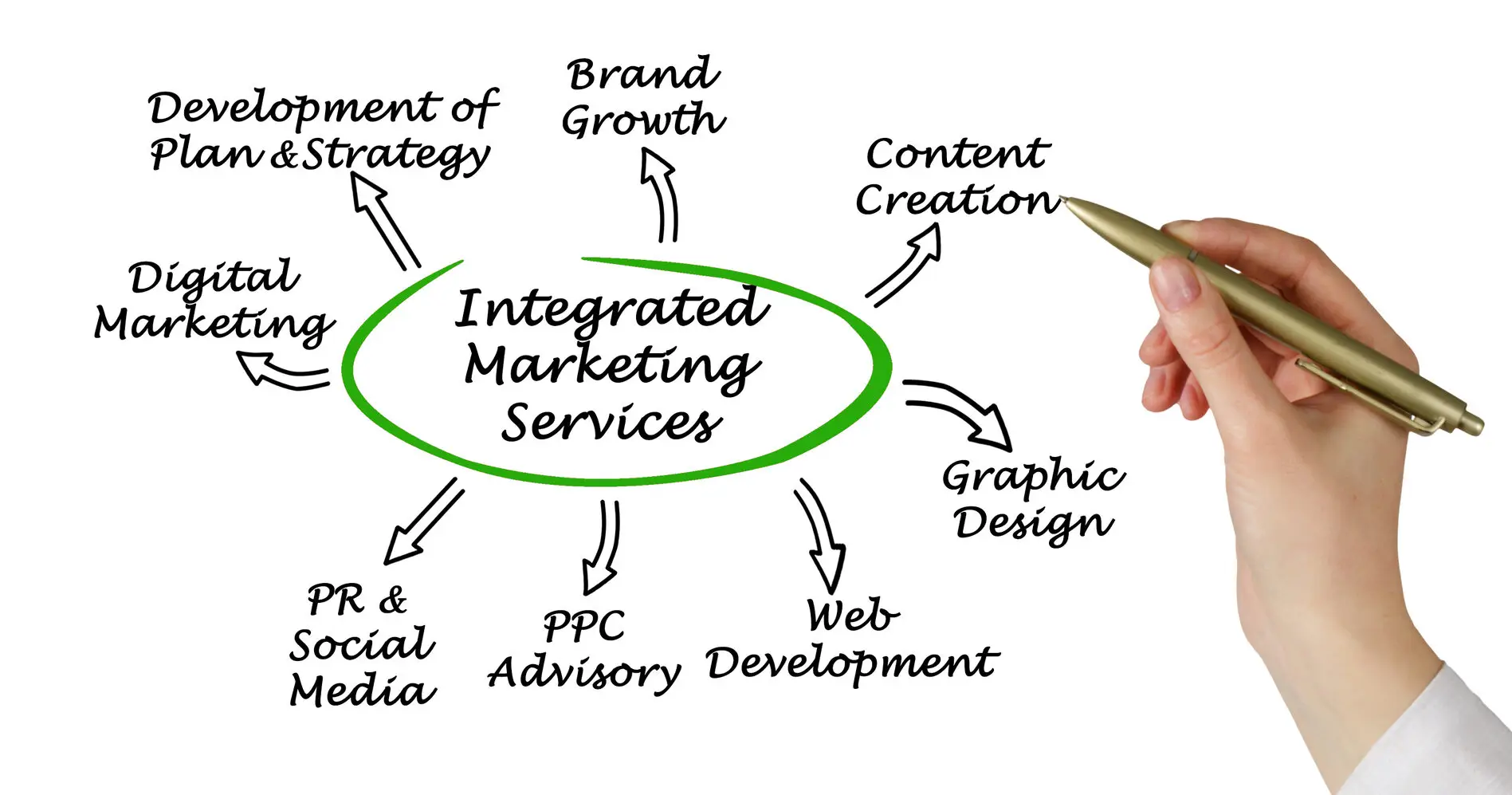
An integrated marketing strategy connects your print, digital, social, and paid advertising into one coordinated system. For Denver businesses and companies across Colorado, this is especially important when you are competing for attention across local and digital channels at the same time. Instead of running each channel separately and hoping for the best, integration means every touchpoint reinforces the same message, tracks toward the same goals, and feeds data back into the same measurement framework.
Most businesses run 3 to 5 marketing channels. Almost none of them are connected. The result: inconsistent messaging, duplicated effort, and no clear way to measure which channels actually drive revenue.
This guide covers how to build an integrated marketing strategy that works for small and mid-size businesses. Not the Fortune 500 version. The practical version – one that connects your channels without a six-figure budget or a 20-person marketing team. We have been building these strategies for Colorado businesses since 2009, and the approach outlined here comes from what we have seen work in practice.
Key Takeaways
- Integration means connection, not presence. Being on five channels is not the same as having five channels that work together.
- Start with 2-3 channels, not all of them. Connect those first. Add more once your foundation is solid.
- Print still works for local businesses. Direct mail averages 4.4% response rates vs. 0.12% for email. The key is connecting it to digital tracking.
- Measurement must be unified. Channel-by-channel reporting hides the real picture. You need a single view across all touchpoints.
- You do not need a massive budget. You need a plan.
What Is an Integrated Marketing Strategy?
An integrated marketing strategy is a coordinated approach where all your marketing channels – print, digital, social media, email, and paid advertising – work together to deliver a consistent message and a connected customer experience. Rather than treating each channel as a separate effort, integration aligns your messaging, timing, and measurement across every touchpoint.
DATA POINT: Companies using an integrated approach see an average of 50% more return on investment compared to running disconnected campaigns. (Optimizely)
The reason is simple: when your channels reinforce each other, each one becomes more effective.
| Factor | Siloed Marketing | Integrated Marketing |
|---|---|---|
| Brand Messaging | Different message per channel | One message adapted per channel |
| Measurement | Separate reports per channel | Unified dashboard, cross-channel attribution |
| Cost Efficiency | Duplicated effort, wasted spend | Shared assets, 50% higher ROI on average |
| Customer Experience | Disconnected, inconsistent touchpoints | Connected, consistent brand experience |
Integrated Marketing Strategy vs Integrated Marketing Campaign
People use these terms interchangeably, but they mean different things. Your integrated marketing strategy is the overall plan – how your channels connect, what your core message is, and how you measure results. An integrated marketing campaign is one specific push within that plan: a product launch, a seasonal promotion, or a lead generation drive run across multiple channels with shared tracking.
The strategy is the playbook. The campaign is one play you run from it.
Think about it from your customer’s perspective. They see your print ad at a Denver coffee shop, visit your website from their phone, get a follow-up email, and then see a retargeting ad on Instagram. If each of those touchpoints tells a different story or uses different visuals, you have wasted the connection. If they all reinforce one clear message, you have built trust across four channels with one advertising campaign strategy.
You do not need a massive budget to make this work. You need a plan.
Signs Your Marketing Channels Are Not Working Together
Before building a new strategy, it helps to know what is broken. Here are the most common signs that your marketing channels are operating in silos:
- Your messaging changes from channel to channel. Your website says one thing, your social media says another, and your print materials tell a third story. Customers notice this faster than you think.
- You cannot track a lead from first touch to conversion. Someone calls your office and you have no idea if they came from a Google ad, a direct mail piece, or an Instagram post.
- Each channel has its own separate budget with no coordination. Your SEO team does not talk to your paid ads manager. Your print campaigns run on a completely different timeline than your digital campaigns.
- Print campaigns have no digital follow-through. You send direct mail or run print ads but give readers no clear path to an online landing page, QR code, or trackable phone number.
- You are duplicating work across teams. Different people create similar content for different channels without a shared content calendar or asset library.
- Your reporting is channel-by-channel, never combined. You see Google Analytics for web, Meta reports for social, and a spreadsheet for print – but never a unified picture of what is actually working.
If three or more of these sound familiar, your marketing campaign planning needs an overhaul. The good news is that fixing integration does not require starting from scratch. It requires connecting what you already have.
Recognizing some of these in your own marketing? We will show you what to fix first and what it will cost to fix it. Email David directly or reach out here for a free 20-minute consultation.
5 Components of an Integrated Marketing Strategy That Actually Works
The five components of an effective integrated marketing strategy are: consistent messaging, audience-based channel selection, print-digital connection, unified measurement, and a shared marketing calendar. Here is what each looks like when you are building one for a real business.
Consistent Brand Messaging Across Every Touchpoint
This goes beyond using the same logo. Consistent messaging means your value proposition, tone of voice, visual identity, and core offers are aligned no matter where someone encounters your brand – on a billboard along I-25, in a Google search result, or in their email inbox.
Start with a one-page messaging guide that includes your primary value proposition, three to five proof points, and your visual standards (colors, fonts, image style). Every channel should pull from this same source.
Channel Selection Based on Your Audience
REALITY CHECK: Most businesses try to be everywhere. That is the opposite of integration. An effective cross-channel marketing strategy starts with two or three channels your audience actually uses, and connects those first.
A B2B professional services firm in the Denver Tech Center does not need TikTok. They need LinkedIn, email, and a solid Google Ads presence. A restaurant in RiNo does not need a white paper strategy. They need Instagram, local SEO, and well-placed print in neighborhood publications.
Pick your channels based on where your customers spend time, not where your competitors post.
Print and Digital Working Together
Most digital-only agencies ignore print. That is a mistake. Print still produces results, especially for local businesses.
DATA POINT: Direct mail response rates average 4.4% compared to 0.12% for email. (Data & Marketing Association)
The key is connecting print to digital so you can measure it. Here is how:
- Add QR codes to every print piece that link to a channel-specific landing page
- Use unique promo codes or phone numbers for each print campaign
- Make sure landing pages are mobile-friendly (most QR scans happen on phones)
- Match the visual look of the print piece to the landing page so the experience feels connected
When a potential customer sees your print ad in a Cherry Creek magazine, scans the QR code, and lands on a page that looks and sounds exactly like the ad they just saw, that is integration. That is what builds trust and moves people to act.
Data-Driven Measurement Across Channels
If you cannot measure it, you cannot improve it. And the biggest problem with siloed marketing is that measurement stays siloed too.
An integrated marketing strategy requires a unified measurement approach. At Creative Options, we use our ModernMind 360° analytics framework to pull data from every channel into a single dashboard. This lets us see which channels are driving leads, which are supporting conversions, and which are wasting money.
Even without a custom analytics framework, you can start with the basics:
- UTM parameters on every digital link so you know where traffic comes from
- Unique phone numbers for print, radio, and offline campaigns
- Google Analytics set up with goals that track actual conversions, not pageviews
- Monthly reporting that shows all channels side by side
A Unified Marketing Calendar
Marketing campaign planning falls apart when each channel runs on its own schedule. Your email team sends a promotion on Monday. Your social team posts about a different topic on Tuesday. Your print ad hits mailboxes talking about last month’s offer.
A unified calendar solves this. One document where every channel’s content, timing, and messaging is visible to everyone involved. It does not need to be complicated. A shared spreadsheet works. What matters is that everyone on your team – or your agency partners – can see what is happening across all channels at any given time.
How to Build Your Integrated Marketing Strategy Step by Step
- Audit your current channels. List every marketing channel you are using right now. For each one, document what messaging you are running, who manages it, what it costs, and how you measure results. This alone will reveal gaps and overlaps.
- Define your core message. Write one clear value proposition that works across every channel. If you cannot say what makes your business different in two sentences, your marketing channels are going to tell different stories.
- Map your customer touchpoints. Walk through how a customer finds you, evaluates you, and decides to buy. Identify every touchpoint from first contact to conversion. Where are the disconnects? Where does someone fall out of the funnel because one channel does not hand off to the next?
How we handle this at Creative Options: This is where most businesses stall. They can see the gaps but do not know how to close them. What we do is build a simple one-page touchpoint map for each client – a visual showing every channel, how they connect, and where the handoffs break. It takes about an hour to build and it changes the entire conversation about where to spend budget.
- Connect your tracking. Set up UTM codes for digital links, unique phone numbers for offline campaigns, QR codes for print pieces, and dedicated promo codes for each channel. This is the infrastructure that makes measurement possible.
- Set KPIs for each channel and review monthly. Every channel should have a defined role (awareness, consideration, conversion) and a specific metric you track. Review performance monthly and adjust budget allocation based on what the data-driven marketing approach shows.
Integrated Marketing Strategy Examples: What This Looks Like in Practice
Theory is easy. Execution is where integrated marketing campaigns succeed or fail. Here are two examples of an integrated marketing strategy in practice, from our work with Colorado businesses.
Results We’ve Seen
Parker medical practice: Was running Google Ads, posting on Facebook, and sending direct mail – all with different messaging, different offers, and no shared tracking. We unified their messaging around a single patient acquisition campaign, connected their print mailers to dedicated landing pages with QR codes, and set up call tracking across all channels. Over 6 months, new patient appointments increased approximately 38% and their cost per acquisition dropped by roughly 22%.
Results We’ve Seen
Highlands Ranch home services company: Relied heavily on word of mouth and one-off print ads. We built an integrated marketing campaign that connected local SEO, Google Ads, direct mail in targeted ZIP codes, and a retargeting campaign on social media. Each channel fed the same CRM pipeline. Within 4 months, qualified leads increased by approximately 52% and they could finally see which channels produced the best return.
Common Mistakes That Break Your Marketing Integration
After 15+ years of building integrated strategies, we see the same mistakes over and over:
- Trying to be on every channel at once. Start with two or three and connect them well. Add channels once your foundation is solid.
- Treating integration as a one-time project. It is an ongoing process. Channels evolve, audiences shift, and your strategy needs to adapt monthly.
- Ignoring print because it is not digital. For local businesses, print still drives results. The key is connecting it to your digital tracking so you can measure it.
- No single person or team owns the strategy. If nobody is responsible for the overall integrated plan, each channel defaults to operating in its own silo.
- Measuring channels in isolation. A social media ad might not convert directly, but it might be the first touchpoint that leads to a Google search and then a phone call. Multi-touch attribution gives you the real picture.
About Creative Options Marketing
Creative Options Marketing is a Denver-based agency that has been helping Colorado businesses grow since 2009. We specialize in building integrated marketing strategies that connect SEO, paid advertising, content marketing, social media, and print into one measurable system.
What sets us apart is ModernMind 360°, our proprietary analytics framework that shows you exactly which channels drive leads and revenue – not vanity metrics. We prove what is working and cut what is not.
Frequently Asked Questions About Integrated Marketing Strategy
An integrated marketing strategy is a coordinated plan that aligns all of your marketing channels – digital, print, social media, email, and paid ads – around a single message and shared goals. Instead of running each channel separately, integration connects them so every customer touchpoint reinforces the same brand story and can be measured together.
An integrated marketing campaign is a specific, time-bound execution of your integrated strategy. It is a coordinated push across multiple channels – like running a promotion simultaneously through email, social media, Google Ads, and direct mail – with consistent messaging and unified tracking so you can see which channels drive results.
The five main components are: consistent brand messaging across all channels, audience-based channel selection, a connection between print and digital efforts, unified data measurement, and a shared marketing calendar. Each channel should have a defined role and specific KPIs tied to your overall business goals.
Start with two or three channels your audience uses most. Create one clear message and adapt it for each platform. Use free tracking tools like UTM parameters and Google Analytics to measure performance. Connect your print to digital with QR codes and unique phone numbers. You do not need to be everywhere. You need to be connected where it matters.
Multi-channel marketing means being present on multiple platforms. Integrated marketing means those platforms work together. You can run ads on five channels without any coordination – that is multi-channel. When those five channels share messaging, timing, data, and measurement, that is integrated. Integration produces better results because each channel reinforces the others.
Track KPIs for each channel (click-through rates, conversion rates, cost per lead) and also measure cross-channel metrics like multi-touch attribution, total cost per acquisition, and customer lifetime value. The goal is a unified dashboard where you can compare channel performance side by side and see how they work together to drive results.
Most businesses see measurable improvements within 60 to 90 days of implementing an integrated approach. Paid channels like Google Ads and social ads show results faster (2 to 4 weeks). SEO and content marketing take longer (3 to 6 months) but compound over time. The biggest immediate win is usually better cost efficiency from eliminating duplicated effort across channels.
Ready to Connect Your Marketing Channels?
We will map out which channels should work together, where your current gaps are, and what it will take to close them. No jargon. No pressure. Just a clear picture of where to start.
Schedule a Free ConsultationOr email David directly at david@creativeoptionsmarketing.com
David Drewitz is a Denver marketing strategist and founder of Creative Options Marketing, a digital marketing agency he started in 2009. Connect with David on LinkedIn.