
A client came to us last year spending $18,000 monthly on Facebook ads. Great click-through rates. Horrible retention. They were acquiring customers but couldn’t keep them past the first purchase. Their entire budget went to direct response with zero investment in branding.
Another business had the opposite problem. Beautiful brand storytelling across social media, gorgeous website, compelling mission statement. And they were broke. They’d spent two years “building awareness” without a single campaign designed to generate revenue now.
Both made the same mistake: treating branding vs direct response marketing as an either/or decision.
Here’s what most marketing advice gets wrong: you don’t choose between branding and direct response. You choose how much of each, and when. Get this balance wrong and you either run out of money before your brand work pays off, or you hit a revenue ceiling because nobody knows who you are.
Key Takeaways
- Branding builds recognition, direct response drives action. Both serve different purposes on different timelines.
- Startups need 70% direct response, 30% branding. Growth-stage businesses perform best at 50/50 allocation.
- Strong branding makes direct response more effective. Recognition and trust improve conversion rates and lower acquisition costs.
- The biggest mistake isn’t choosing wrong. It’s switching strategies too soon before they pay off.
- Track different metrics for each approach. Branding uses awareness and sentiment; direct response uses conversions and ROI.
- Most businesses need both working together. Integrated strategies balance immediate revenue with sustainable growth.
What is Branding vs Direct Response Marketing?
Here’s the fundamental difference:
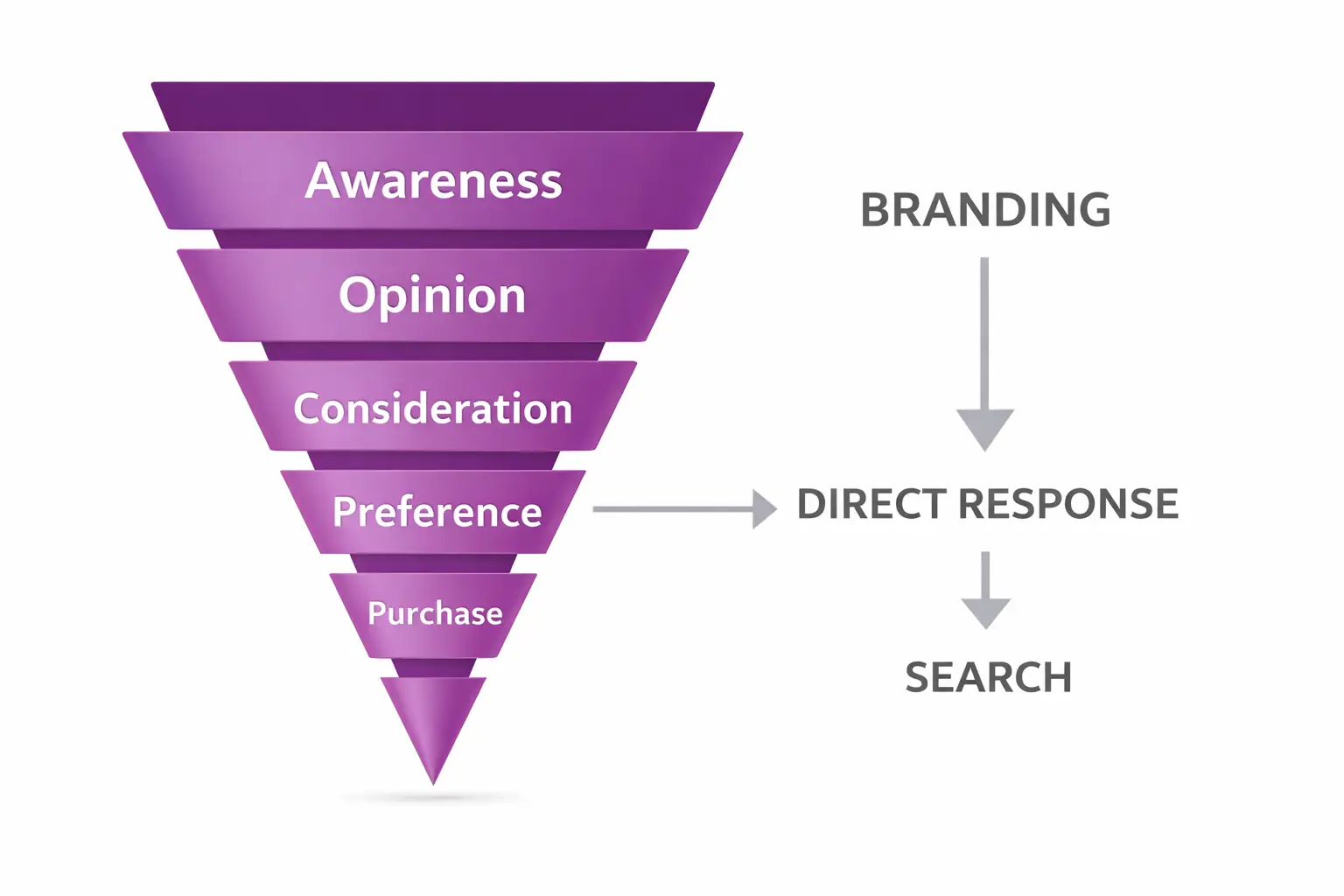
Branding creates long-term recognition and emotional connection with your audience. It answers the question: “Why should people choose us when they’re ready to buy?”
Direct response marketing generates immediate action. It answers: “How do we get people to buy right now?”
Direct response advertising includes tactics like pay-per-click ads, email campaigns with specific offers, retargeting, and conversion-focused landing pages. Every element exists to drive measurable action (a purchase, signup, download, or call).
Marketing expert Jason Falls puts it perfectly: “Direct response marketing helps people buy. Brand marketing helps people choose.”
| Aspect | Branding | Direct Response |
|---|---|---|
| Goal | Build recognition and trust | Drive immediate action |
| Timeline | Months to years | Days to weeks |
| Measurement | Awareness, sentiment, recall | Conversions, ROI, cost per acquisition |
| Message Type | Emotional, values-driven | Offer-focused, action-oriented |
| Success Metric | Share of mind | Response rate |
Both matter. You need people to remember you (branding) and you need them to act when you make an offer (direct response).
How Branding and Direct Response Marketing Differ
The differences go deeper than just timeline and goals. Here are five ways these approaches diverge:
1. Timeline and Expectations
Branding plays the long game. Dr. Jeffrey Lant’s Rule of 7 states that it takes an average of seven brand touches before customers recognize you. You’re building memory structures that pay off when someone enters the market months or years later.
Direct response wants action now. If your campaign isn’t generating measurable responses within days or weeks, something’s wrong.
2. Messaging and Creative
Branding tells stories. It communicates values, builds emotional connections, and creates differentiation beyond price or features. Think Nike’s “Just Do It” or Apple’s focus on creativity and innovation.
Direct response makes specific offers with clear calls to action. “Call now,” “Limited time,” “Get 50% off today.” The creative exists to drive the response, not to win awards.
3. Channels and Placement
Branding spreads messages across channels where your audience spends time (social media, content marketing, PR, sponsorships). Brand awareness marketing requires repeated exposure in the right contexts. You’re building mental availability so people think of you when they need what you sell.
Direct response advertising targets people ready to act. Examples include email campaigns with limited-time offers, Google Ads targeting high-intent keywords, retargeting ads following website visitors, and direct mail with clear response mechanisms. Channels get picked based on response rates, not reach alone.
📊 DATA POINT: Direct response advertising examples that consistently work in our client campaigns: abandoned cart emails (average 18% conversion rate), retargeting ads for cart abandoners, search ads for “near me” queries, and time-sensitive promotional campaigns.
4. Measurement Approach
Branding metrics include brand awareness, aided and unaided recall, net promoter score, and share of voice. These indicators matter, but they’re indirect. You’re measuring mental availability, not immediate sales.
Direct response lives and dies by numbers: response rate, conversion rate, cost per acquisition, customer lifetime value, ROI. Every element gets tested and optimized based on what converts.
5. Risk and Testing
Branding campaigns typically run longer before you know if they’re working. You commit resources based on strategy and creative strength, then wait to see results. The risk is higher because the feedback loop is slower.
Direct response provides immediate feedback. If an email campaign isn’t working by day three, you can adjust the subject line, offer, or audience. Testing happens continuously, reducing risk through rapid iteration.
When to Use Branding vs Direct Response Marketing
So which approach should you use? The answer depends on your situation.
Use Branding When:
- You’re launching a new business or entering a new market
- You’re in a crowded category where differentiation matters
- Your sales cycle is long (B2B services, high-ticket items)
- You’re building for sustainable competitive advantage
- Your category involves emotional purchasing decisions
Use Direct Response When:
- You need revenue now
- You’re launching a new product or promotion
- You have limited budget and need measurable ROI
- You’re testing offers or positioning
- Your audience is in active buying mode
Use Both When:
This is where it gets interesting. Most businesses shouldn’t choose one or the other exclusively.
A Denver coffee shop might run brand-building social media content about their sustainable sourcing and barista training programs (branding), while also sending weekly email offers for “happy hour pricing 3-5 PM” (direct response).
A B2B software company might publish thought leadership content and sponsor industry events (branding), while running targeted LinkedIn ads with free trial offers (direct response).
The branding creates favorable conditions for direct response to work better. When people recognize your brand and have positive associations, your offers get better response rates.
How to Allocate Between Branding and Direct Response
Here’s a framework based on your business stage:
After 15+ years running Creative Options Marketing, I’ve seen this pattern repeat: businesses that survive focus on direct response early, then gradually shift toward branding as they grow. The ones that fail do the opposite (they brand before they have revenue to sustain it, or they rely solely on direct response and hit a ceiling when acquisition costs spike).
The allocation isn’t just about budget percentages. It’s about timing and sequencing.
Startup or New to Market (0-2 years):
- 70% direct response, 30% branding
- You need revenue to survive
- Use direct response to prove your model works
- Start building brand recognition gradually
Growth Stage (2-5 years):
- 50% direct response, 50% branding
- Balance immediate revenue with long-term positioning
- Your branding makes direct response more efficient
- Invest in differentiation as competition increases
We worked with a regional healthcare network in this stage. They were spending 80% on direct response (Google Ads, patient acquisition campaigns) and only 20% on branding. Their cost per acquisition kept climbing as competition increased.
We shifted them to 50/50 allocation (maintained their direct response budget but added consistent branding through content marketing, physician profiles, and community engagement). Within six months, their brand awareness in target zip codes increased 34%, and their direct response CPA dropped 22%. The branding work made their ads more effective.
Established Business (5+ years):
- 30-40% direct response, 60-70% branding
- You have market position to defend
- Branding protects margins and creates preference
- Use direct response tactically for new offers or seasonal pushes
⚠️ REALITY CHECK: Research by Les Binet and Peter Field in “The Long and the Short of It” found that businesses achieve optimal results with roughly 60% brand building and 40% sales activation over time. Their analysis of thousands of campaigns supports this allocation for established businesses.
How to Measure Success for Each Approach
You can’t improve what you don’t measure. Here’s what to track:
For Branding Campaigns:
- Brand awareness (aided and unaided)
- Brand sentiment and perception
- Share of voice in your category
- Website traffic (organic and direct)
- Social media engagement and reach
- Net promoter score
- Customer lifetime value trends
These metrics move slowly. Don’t panic if you don’t see immediate changes. Track monthly and look for trends over quarters.
For Direct Response Campaigns:
- Response rate
- Conversion rate
- Cost per acquisition (CPA)
- Return on ad spend (ROAS)
- Customer acquisition cost (CAC)
- Revenue per campaign
- Email open and click rates
These metrics update quickly. You should have meaningful data within days or weeks.
For Integrated Campaigns:
Track both sets of metrics and look for correlations. Many businesses find that increased brand awareness (from branding efforts) improves direct response performance. Lower CPAs and higher conversion rates indicate that branding is doing its job.
Common Mistakes to Avoid
Here’s what most marketing advice won’t tell you: the biggest mistake isn’t choosing the wrong approach. It’s switching too soon.
I see businesses panic when branding doesn’t produce sales in 60 days, or when direct response stops working after 18 months. They abandon the strategy right before it would have paid off.
Mistake 1: Choosing One and Ignoring the Other
Businesses that only do direct response often hit a ceiling. They acquire customers but struggle to command premium prices or build loyalty. Businesses that only do branding often run out of money before the brand work pays off.
Mistake 2: Using the Wrong Metrics
Measuring branding campaigns by immediate sales or direct response campaigns by awareness creates frustration. Each approach needs its own success criteria.
Mistake 3: Inconsistent Brand Messaging in Direct Response
Your promotional emails and ads still represent your brand. If your direct response creative contradicts your brand positioning, you’re working against yourself.
Mistake 4: Expecting Immediate ROI from Branding
Branding is an investment with delayed returns. If you need immediate results, use direct response. Don’t waste branding budget if you can’t wait months for payback.
Mistake 5: Not Testing Direct Response Enough
Direct response allows rapid testing of offers, creative, and audiences. Businesses that run the same campaign repeatedly without optimization leave money on the table.
Why Most Businesses Need Both
Marketing isn’t actually a choice between branding and direct response. It’s about finding the right balance for your situation.
Direct response fills your pipeline and generates revenue. Branding makes that direct response more effective by creating preference and reducing price sensitivity.
Customers don’t separate “brand impressions” from “sales messages” in their minds. They experience your business as a whole. Every touchpoint either builds or erodes your position.
A strong brand amplifies direct response results. Recognition, trust, and positive associations all improve response rates and lower acquisition costs. Meanwhile, consistent direct response campaigns reinforce brand messages through repeated exposure.
The businesses that win combine both approaches strategically. They use direct response to drive immediate results while investing in brand building that compounds over time.
Frequently Asked Questions
What is the main difference between branding and direct response marketing?
Branding builds long-term recognition and emotional connection with your audience, creating preference when they’re ready to buy. Direct response marketing drives immediate action through specific offers and clear calls-to-action. Branding asks “why choose us?” while direct response asks “buy now.”
How much should I spend on branding vs direct response?
Allocation depends on your business stage. Startups should spend 70% on direct response and 30% on branding to generate revenue. Growth-stage businesses perform best at 50/50. Established businesses can shift to 60-70% branding and 30-40% direct response to protect market position.
Can you do both branding and direct response at the same time?
Yes, and most businesses should. Direct response fills your pipeline while branding makes those campaigns more effective by creating recognition and trust. The best approach combines brand storytelling with conversion-focused tactics. We help businesses across Denver, Boulder, and Colorado Springs develop integrated strategies that balance both.
What are examples of direct response advertising?
Common examples include Google Ads with specific offers, email campaigns with discount codes, retargeting ads following website visitors, direct mail with response cards, and social media ads with “shop now” buttons. Any advertising designed to generate immediate measurable action qualifies as direct response.
How long does branding take to show results?
Brand building typically requires 6-12 months before you see measurable impact on awareness and preference. Dr. Jeffrey Lant’s Rule of 7 suggests seven brand touches before customers recognize you. Direct response shows results in days or weeks, making it easier to measure but less sustainable long-term.
Creative Options Marketing is a Denver-based digital marketing agency founded in 2009. We help businesses across Denver, Boulder, Colorado Springs, Aurora, and Fort Collins grow through strategic marketing that balances brand building with direct response tactics.
Ready to find the right balance for your marketing? Get in touch and let’s talk about your strategy.
Disclaimer: This article provides general marketing strategy education and should not be considered professional advice specific to your business. Marketing approaches vary by industry, business stage, and market conditions. Consult with qualified marketing professionals before making significant budget allocations or strategic changes.